Although we often think of DNA as our body's “immutable blueprint,” it is actually a dynamic molecule. Changes in it throughout the life cycle are inevitable and occur for several main reasons — from natural wear and tear to the fine-tuning of how our organs function.
Epigenetic Changes: Light Switches on Your DNA
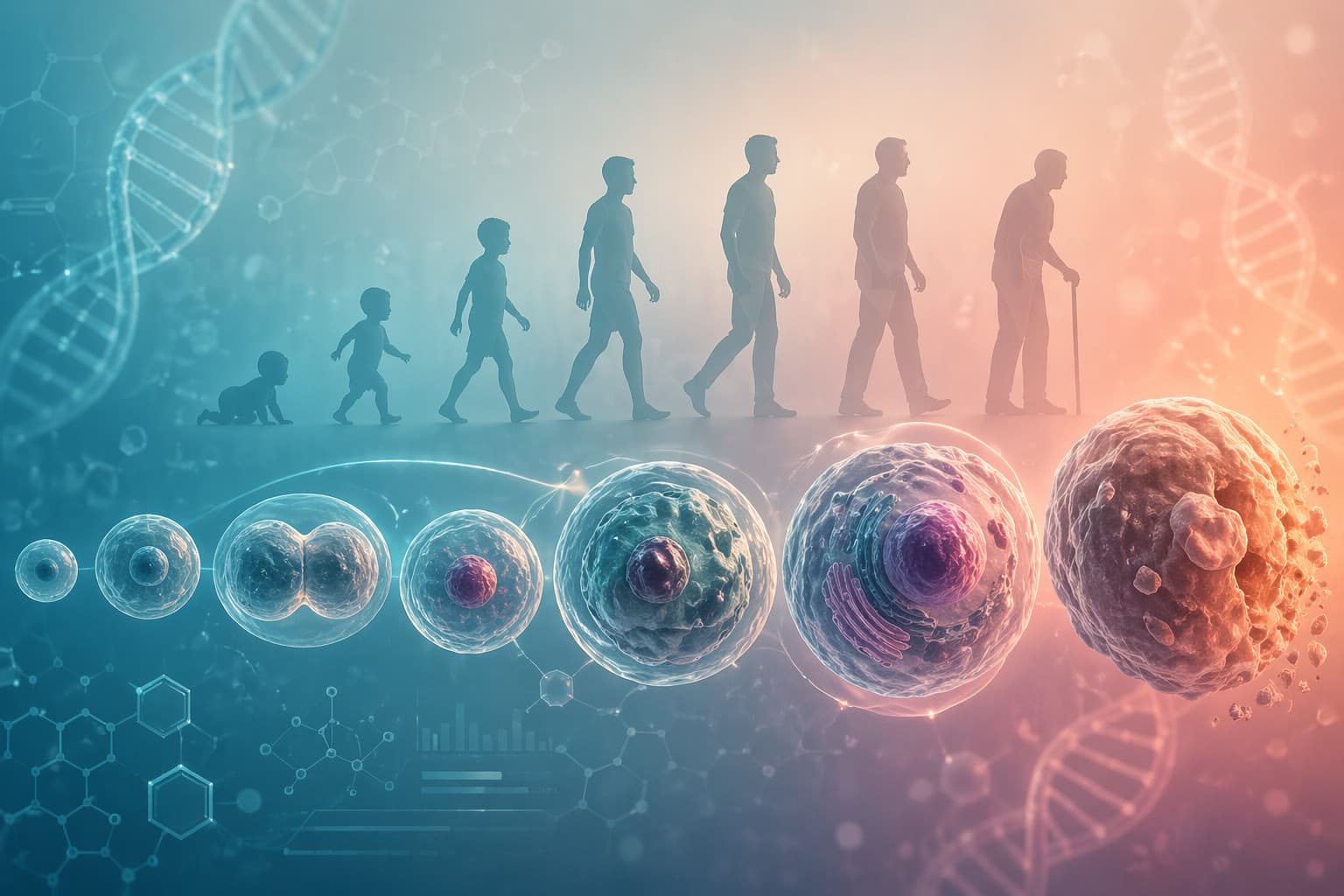
The first of these are epigenetic changes — over time, small chemical groups (methyl groups) are added to the DNA, acting like light switches that turn certain genes on and off. Why does this happen? The body adapts to its environment. For example, a baby's DNA is tuned for growth so that cells divide at a colossal speed to build tissues and organs. During this stage, the cells are fully active — they have no epigenetic “obstacles” (Jones & Baylin, 2002).
When a person reaches maturity, the body's priority shifts from growth to maintenance. If the functionality of a cell in the embryonic stage through the first years of life remained active in an adult, the result would not be endless growth of muscles and bones, but oncogenesis — cancer (Blagosklonny, 2006). Cancer is practically a cell that has “forgotten” it is an adult and has reactivated its embryonic programs for aggressive division. One of the main ways it does this is by reactivating the enzyme telomerase, which makes cells practically immortal (Kim et al., 1994). To prevent this, the body uses these epigenetic mechanisms (so-called methylation) to “silence” these genes in the cell's DNA.
Cellular Senescence: The Double-Edged Sword
Regardless of what stage of life we are in and how our cells are “adapted” to the body's needs, they work and divide continuously. However, sometimes a cell gets “damaged,” and if that cell continues to work and multiply, it can turn into cancer. To protect itself, the body tells the damaged cell: you are dangerous, so stop dividing! This process is called cellular senescence.
The problem is that these cells do not die and do not leave the body — they release a cocktail of chemicals that destroy surrounding healthy tissues. The skin wrinkles, the joints start to ache, the muscles weaken. Ironically, cellular senescence helps a young organism “turn off” damaged cells to prevent inflammatory processes, but in old age this exact same rescue mechanism has a terrible side effect — it is the main reason our bodies break down and get sick when we grow old (Campisi, 2000).
Somatic Mutations: Accumulated Typos
During division, the cell copies 3 billion “letters” of genetic code. Sometimes mistakes happen — caused by external factors such as ultraviolet rays, radiation, and chemicals like those in cigarette smoke. They directly damage the chemical bonds of DNA, leading to changes in the code. Most are harmless or are repaired by cellular mechanisms. Over time, however, there is an accumulation of so-called somatic mutations (Alberts et al., 2022).
V(D)J Recombination: DNA That Rearranges Itself
The last of the main mechanisms by which our DNA changes is the recombination of the immune system. An interesting fact is that the DNA in some cells is intentionally altered. V(D)J recombination means that our white blood cells literally “rearrange” parts of their DNA to create millions of different antibodies. This is the reason our immune system can recognize a virus it has never encountered before. This deliberate rearrangement of our DNA is so astonishing and vital for our survival that its discovery earned the Japanese scientist Susumu Tonegawa a Nobel Prize in Medicine (Hozumi & Tonegawa, 1976).
Your Control Panel: How Biohacking Slows Down the Clock
The good news is that we are not merely passive observers of how our DNA wears out and changes. This is where biohacking comes in — the conscious management of our biological “software.” Through our daily habits, we are literally sending new instructions to our cells.
A nutrient-rich diet and avoiding toxins act as a shield, protecting the genome from the accumulation of those fatal “typos” (somatic mutations). At the same time, deep sleep and regular exercise drastically reduce oxidative stress, which directly slows down the shortening of telomeres — keeping the plastic tips of our DNA strands healthy for longer.
Even more impressive is our influence on inflammation and cellular senescence. Practices such as quality recovery, stress management, and intermittent fasting stimulate the body to recognize and clear out these “damaged but not dead” cells on its own, before they have caused harm to surrounding tissues.
The end result? Through food, movement, and sleep, we keep the epigenetic switches for youth and recovery turned on, and those for disease and inflammation deeply asleep.
References
- Blagosklonny, M. V. (2006). Aging and Immortality: Quasi-Programmed Senescence and its Pharmacologic Inhibition. Cell Cycle, 5(18), 2087–2102. https://doi.org/10.4161/cc.5.18.3288
- Kim, N. W., Piatyszek, M. A., Prowse, K. R., Harley, C. B., West, M. D., Ho, P. L. C., Coviello, G. M., Wright, W. E., Weinrich, S. L., & Shay, J. W. (1994). Specific Association of Human Telomerase Activity with Immortal Cells and Cancer. Science, 266(5193), 2011–2015. https://doi.org/10.1126/science.7605428
- Campisi, J. (2000). Cancer, aging and cellular senescence. In Vivo, 14(1), 183–188. https://pubmed.ncbi.nlm.nih.gov/10757076
- Alberts, B., Heald, R., Johnson, A., Morgan, D., Raff, M., Roberts, K., & Walter, P. (2022). Molecular biology of the cell (7th ed.). W. W. Norton & Company.
- Hozumi, N., & Tonegawa, S. (1976). Evidence for somatic rearrangement of immunoglobulin genes coding for variable and constant regions. Proceedings of the National Academy of Sciences, 73(10), 3628–3632. https://doi.org/10.1073/pnas.73.10.3628
- Jones, P. A., & Baylin, S. B. (2002). The fundamental role of epigenetic events in cancer. Nature Reviews Genetics, 3(6), 415–428. https://doi.org/10.1038/nrg816