
Imagine two people celebrating their 40th birthday today. On paper, they are identical, but if we look beneath the surface, at the cellular level — one might have the energy and healthy body of a 30-year-old, while the other carries the biological burden of a 60-year-old.
In a study by Belsky et al. (2015), researchers examined why at high school reunion gatherings, some people look younger than others, even though everyone was born in the same year. They found the answer in the study Quantification of biological aging in young adults, published in the prestigious journal PNAS in 2015. There, scientists examined 954 participants from the famous Dunedin Study, all born in 1972–1973. They tracked 18 different physiological markers reflecting the functions of the cardiovascular, metabolic, and immune systems, as well as the condition of the kidneys, liver, lungs, teeth, and DNA at three key moments in their lives: at 26, 32, and 38 years of chronological age.
The main findings of this research were that regardless of their identical chronological age (38 years), their calculated “biological age” varied across a wide range — from 28 to 61 years! Participants who aged faster compared to the other tested individuals showed poorer physical capabilities, worse results on cognitive tests, and signs of aging in brain vessels, even before reaching middle age. Individuals who aged biologically faster more frequently reported poorer overall health. Furthermore, they were evaluated by an independent group of people based solely on their photographs and were judged as visually older than their actual years.
The Epigenetic Answer
Part of the answer to the question “why is there a difference between chronological and biological age” actually lies in epigenetic research. Imagine your DNA is a massive cookbook for building the body — in fact, a cell in your liver and one in your brain are identical in this regard. The difference between them, however, is the epigenetic markers they use. They act like colored bookmarks in your cookbook, marking which recipes to read and which to ignore. These “bookmarks” are called DNA methylation.
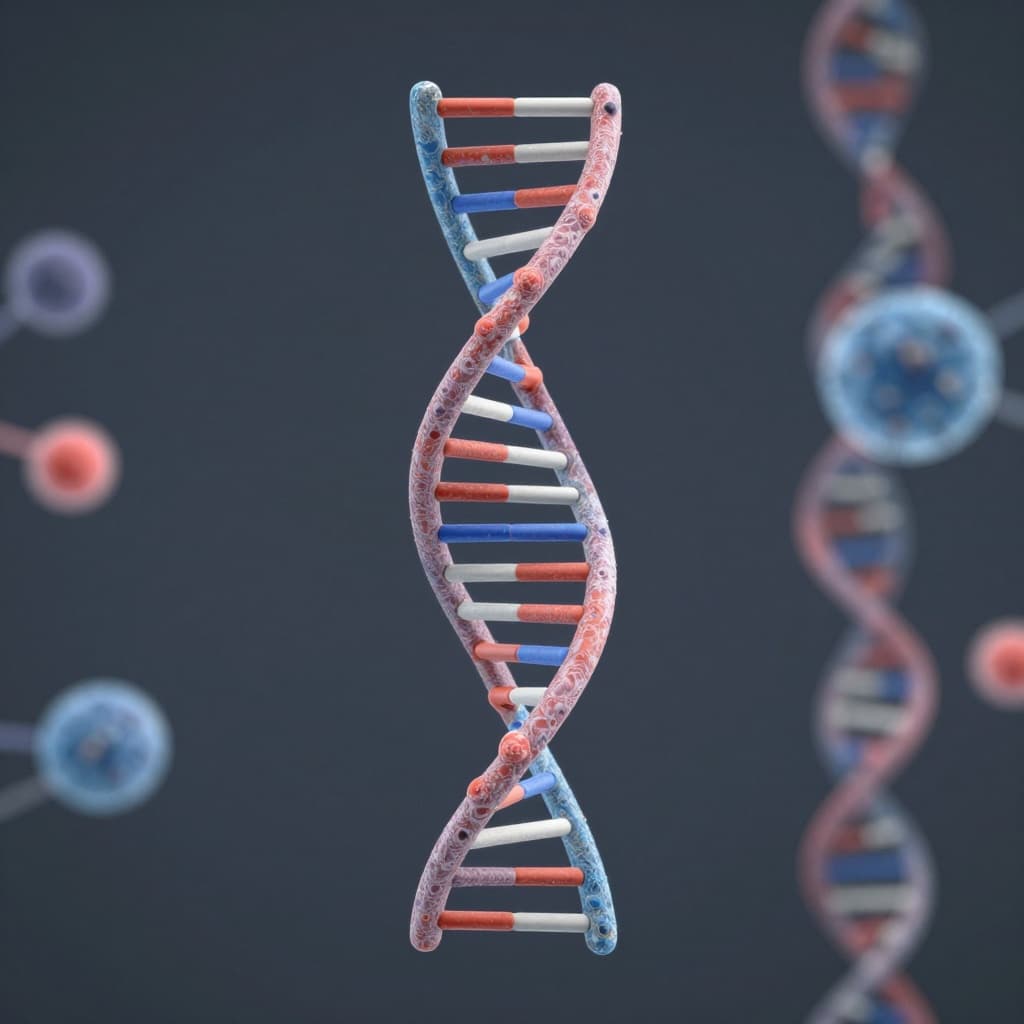
Steve Horvath (a German-American aging researcher, geneticist, and biostatistician, and a professor at the University of California, Los Angeles) in his article DNA methylation age of human tissues and cell types (2013) demonstrated a revolutionary discovery in epigenetics. He proved that over time, these “bookmarks” do not change chaotically, but follow an extremely strict, mathematically predictable model.
Horvath took data from over 8,000 samples of various human tissues (blood, brain, muscle, liver, etc.) and discovered patterns using computer algorithms. Out of millions of possible DNA sites, he found exactly 353 where the methylation level acts like a Swiss watch with 353 tiny cogs — some turning backward, others forward. By measuring the chemical state of just these 353 sites, we can determine a person's age with astonishing accuracy (typically with a margin of error under 3 years).
This discovery by Horvath measures your biological age, not just your chronological one. It actually measures how “worn out” or aged your cells are. Sometimes, the “internal clock” shows that the cells are older or, conversely, younger than a person's chronological age.
From Reactive to Proactive Health
The goal of these scientific studies is to reverse the direction of standard medicine, which currently treats diseases that have already developed. In contrast, biohacking is proactive; it doesn't wait for the body to stop functioning well before taking care of it.
With the right tools, such as epigenetic tests, blood biomarkers, and physical tests, we can discover a working recipe for our body. With proper nutrition, dietary supplements, and training, we can turn our body into a Swiss watch and even turn back time. And we are here to facilitate the journey toward creating the perfect recipe that works for your body.
Bonus Interesting Facts
- The beginning of life is “zero”: Horvath tested stem cells (the cells at the very beginning of embryonic development, from which all others originate). Their clock shows an age close to 0. Their “recipe books” are completely clean, without any accumulated age marks.
- Cancer “fast-forwards” the clock: When Horvath tested cancerous tumors, he discovered something startling. Cancer cells are biologically much older (by an average of 36 years!) than the healthy tissues of the same person. Cancer is not simply uncontrollable division; it leads to a drastic, accelerated aging of the tissue itself.
- Universality: Horvath's clock works flawlessly for almost all organs in the body. Furthermore, it can even predict the age of our evolutionary cousins, chimpanzees. This means that the aging mechanism is deeply rooted in mammalian biology.
References
- Belsky, D. W., Caspi, A., Houts, R., Cohen, H. J., Corcoran, D. L., Danese, A., Harrington, H., Israel, S., Levine, M. E., Schaefer, J. D., Sugden, K., Williams, B., Yashin, A. I., Poulton, R., & Moffitt, T. E. (2015). Quantification of biological aging in young adults. Proceedings of the National Academy of Sciences, 112 (30), E4104–10. https://doi.org/10.1073/pnas.1506264112
- Horvath, S. (2013). DNA methylation age of human tissues and cell types. Genome Biology, 14 (10), R115. https://doi.org/10.1186/gb-2013-14-10-r115